Redefining the Downtown Luxury Play: Lessons from the Past and the Future of Marina South
For years, investing in Singapore’s Core Central Region (CCR) was considered the ultimate symbol of wealth preservation. The promise of an iconic skyline, premium postal codes, and elite status drew significant capital into the financial district.
However, a raw look at historical data reveals that legacy luxury often came with severe structural blind spots. By analyzing data from PropChaq.sg for two of the downtown core’s most recognizable giants—The Sail @ Marina Bay and Marina One Residences—we can extract the core warnings of the past, and understand how a next-generation project like One Marina Gardens completely corrects the playbook.
1. The Entry Price Paradox: Demanding a Safety Margin
The first and most critical rule of real estate is that prestige does not guarantee a profit margin; your entry price dictates your destiny. When we strip away marketing noise and look directly at the surrounding transaction trends, the contrast is stark:
- The Sail @ Marina Bay: The data shows that the property over the years returned +10.1% when comparing 2025 average prices against 2022 averages, sustaining a current estimated average of $2,071 psf. Why? Because its early buyers entered during initial launch cycles at a highly optimized baseline, leaving them an immense safety cushion to weather future market shifts.
- Marina One Residences: Conversely, Marina One stands as a cautionary tale, returning -18.2% over the exact same period, with its average sliding to $1,910 psf. Legacy owners who bought at the absolute peak of a previous market cycle entered at inflated premiums ($2,300 to $2,500+ psf), leaving zero margin for error when the secondary market adjusted.
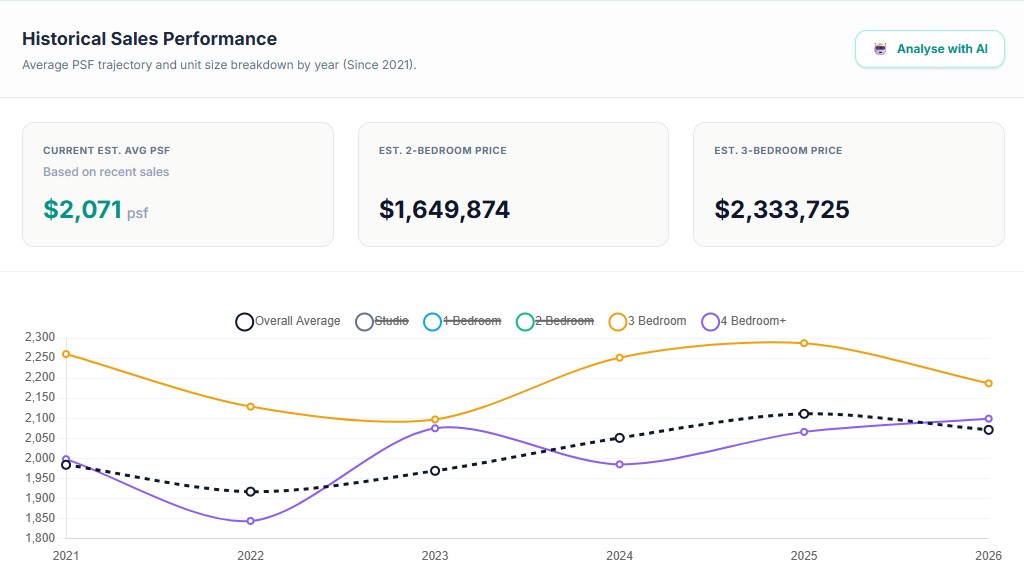
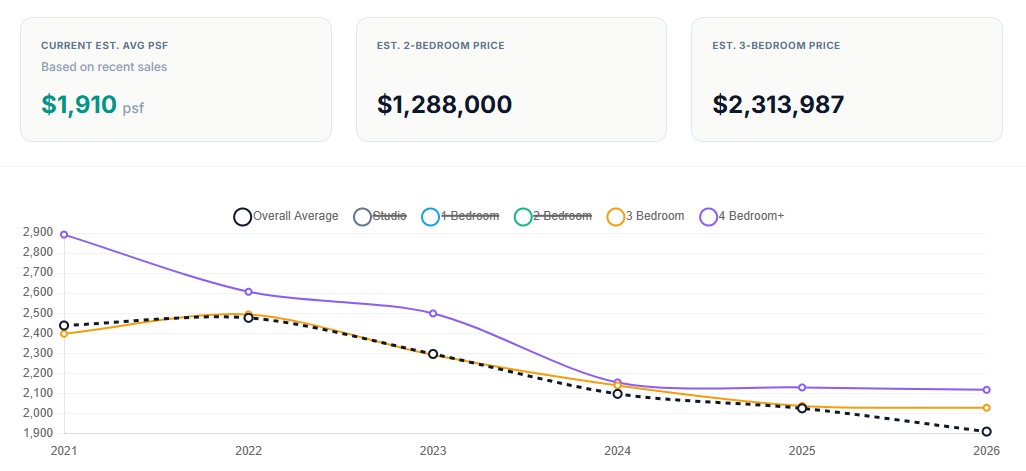
Both of these older projects suffer from an identical bottleneck: The Mega-Project Exit Jam. The Sail holds 1,111 units while Marina One holds 1,042 units. In both developments, PropChaq highlights that exit strategies face intense, active competition from identical layouts within the project, forcing sellers to compete directly against their immediate neighbors on price.
The Next-Gen Pivot at One Marina Gardens
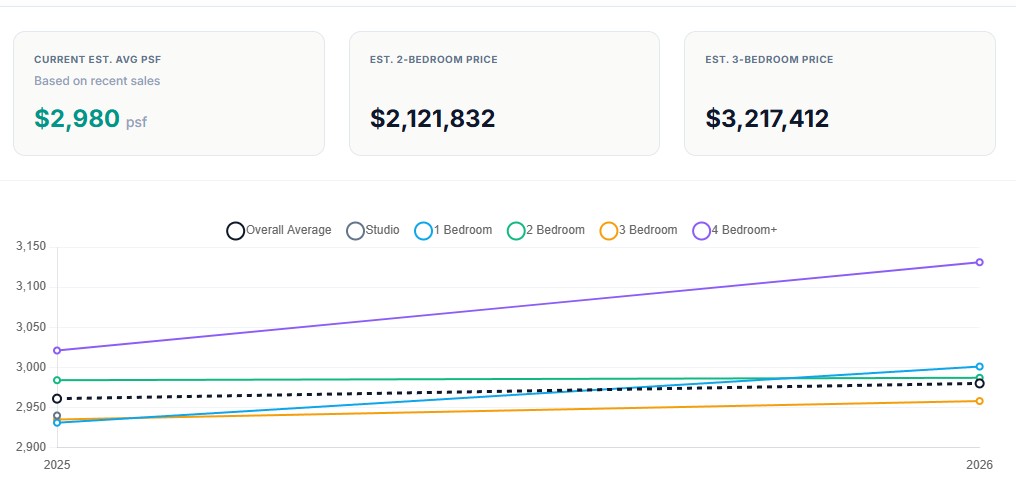
Older towers suffered because their launch pricing swallowed all future upside. One Marina Gardens rewrites this narrative through pricing discipline. The property has already launched at an average launch price of $2,725 psf (as illustrated by the pricing trends in the chart below). Entering a major urban master plan at a controlled first-mover price ensures that buyers capture the safety margin that legacy Marina One buyers missed out on.
2. Navigating the 60% ABSD Policy Shift
The implementation of the 60% Additional Buyer’s Stamp Duty (ABSD) for foreign buyers fundamentally altered the luxury real estate ecosystem overnight. High-density downtown towers that historically relied on speculative international wealth to sustain high-premium transactions saw their primary buyer pool evolve.
Without endless foreign capital to absorb luxury premiums, downtown assets must possess deep fundamental value that appeals to a broader, more sustainable audience—including local high-earning professionals, permanent residents, and domestic corporate funds. Properties that rely solely on flashiness without lifestyle utility face downward pricing pressure, whereas assets optimized for modern domestic and corporate tenant demands inherit true market resilience.
3. The "Singaporean Context": Shifting from Office Jungles to Livable Precincts
Historically, local Singaporean buyers shied away from the traditional financial core. The reasoning was simple: District 01 was a concrete corporate jungle designed for transient workers. It completely lacked the family-friendly, community-driven ecosystem—like child development facilities, accessible green spaces, and neighborhood conveniences—that domestic buyers demand when deploying millions of dollars.
Furthermore, the government’s strict "car-lite" urban planning strategy presented a massive logistical headache for vehicle owners in older builds. Car-lite does not mean a ban on owning a vehicle; instead, the Land Transport Authority (LTA) deliberately restricts the number of physical parking lots a developer can build in transit-heavy zones to curb traffic.
- At Marina One Residences: A physical deficit of 971 lots for 1,042 units means parking is unbundled from ownership. Residents are forced to pay a monthly recurring MCST subscription fee (historically $192.60/month) just to park their first car.
- At The Sail: Second vehicles or visiting family members are subjected to grueling commercial season parking rates or steep hourly CBD ERP surcharges, turning casual family hosting into a major hurdle.
How One Marina Gardens Solves the Lifestyle Deficit
Instead of fighting the car-lite framework, One Marina Gardens adapts to it intelligently to build a highly optimized asset. Out of its 937 units, the layout allocation is heavily geared toward 1 and 2-bedroom configurations (accounting for roughly 45% of the development). This layout distribution aligns perfectly with the LTA's car-lite layout of 445 physical parking lots:
By intentionally designing the project for high-earning tech and financial professionals, single urbanites, and elite corporate tenants who utilize the seamless, direct underground link to the Marina South MRT Station downstairs, the parking ratio ceases to be a limitation. Instead, it becomes a key asset feature. For the premium 3 and 4-bedroom multi-generational units, a car park space transforms into an elite, highly insulated commodity.
Crucially, One Marina Gardens rectifies the "office jungle" flaw by integrating community infrastructure directly into its architecture. The development features four commercial shop spaces, two restaurant units, and a dedicated, sprawling ~500 sqm childcare center right on the first level. Combined with an elevated landscaped bridge connecting residents directly to Gardens by the Bay and Marina Coast Park, the project transitions the area from a cold financial district into a vibrant, highly livable 10-minute neighborhood.
The Verdict
The transaction histories of legacy CCR mega-projects prove that buying blindly into the skyline can lead to rigid exit traps if your entry price is inflated and your property lacks local livability.
The ultimate verdict for modern investors is clear: Avoid the legacy mistakes of the past by backing projects engineered for the future. One Marina Gardens stands out because it systematically addresses the vulnerabilities of older downtown builds. By pairing a highly defensive, optimized average launch price ($2,725 psf) with modern community amenities like on-site childcare and seamless transit connectivity, it shifts the downtown narrative completely. For forward-thinking investors looking to capture a true first-mover advantage in Singapore’s next-generation waterfront precinct, this represents the corrected playbook.